

Weight-Based Liquid Filling: A Comprehensive Guide to Automatic and Semi-Automatic Solutions
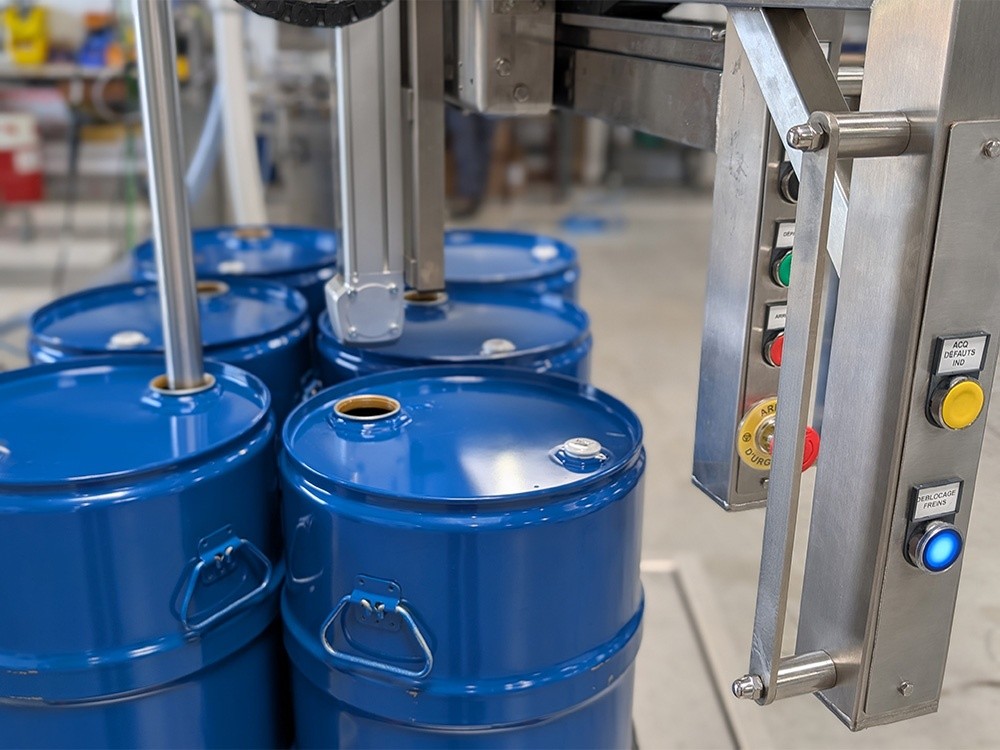
Packaging liquid products demands high standards of precision, hygiene, and industrial efficiency. Among the dosing technologies available on the market, net-weight filling stands out as one of the most reliable methods.
As a French specialist in packaging machinery, Stoppil designs weight-based filling equipment tailored to the needs of the food, chemical, cosmetics, and pharmaceutical industries.
Discover how this technology works, its key benefits and limitations, as well as a comparative guide to help you choose between automatic and semi-automatic equipment.
What is net-weight filling?
Net-weight filling relies on the direct measurement of the product's mass dispensed into its container. Unlike volumetric or flow-meter dosing (which measure volume or flow rate), the machine monitors net weight using an integrated scale or load cell.
The filling nozzle opens, the liquid flows, and as soon as the weight setpoint defined on the human-machine interface (HMI) is reached, the flow stops instantly.
Advantages and limitations of net-weight filling
Key strengths
- Accuracy and metrological compliance: This is the primary advantage of weighing. It eliminates discrepancies caused by fluid density variations, ensuring strict compliance with legal metrology standards.
- Insensitivity to physical variations: Changes in temperature, aeration, or product viscosity do not affect the target dose.
- Non-contact with the product: The load cell is positioned beneath the platform or conveyor. It never comes into direct contact with the liquid, simplifying cleaning and preventing cross-contamination.
- Container flexibility: The filling range is extremely broad—from a few hundred grams to several dozen kilograms—without requiring change parts.
Limits
- Sensitivity to mechanical vibration: Because scales are highly sensitive, surrounding vibrations (adjacent conveyors, forklift traffic) can occasionally disrupt measurement if the machine is not properly isolated.
- Tare weight variation: Accuracy depends on consistent tare weights of empty containers. Significant weight variations among containers may require systematic tare adjustment for each unit.
- Moderate speed: The time required for the scale to stabilize before shutting off the flow can make this technology slower than volumetric dosing.
Stoppil net-weight fillers: automatic vs. semi-automatic
Depending on your production volumes, space constraints, and automation goals, STOPPIL offers two distinct approaches: automatic or semi-automatic weight-based fillers.
|
Criteria |
Semi-Automatic machine |
Automatic machine |
|
Operator involvement |
Manual loading, triggering, and capping by the operator. |
Chargement, transfert et indexage automatisés des flacons et bidons. |
|
Flexibility |
Maximum : Ideal for short runs and frequent container changeovers. |
High: Toolless quick changeovers and format selection via saved recipes (HMI). |
|
Ideal profile |
VSEs, SMEs, small batches, large-volume containers/drums (1 to 60 kg). |
Industrial lines, high-repeatability formats. |
|
Investment |
Lower initial cost, fast onboarding. |
Higher budget, ROI driven by high volumes.
|
Which solution best suits your process?
Choose a semi-automatic system if you package products in large volumes (drums, jerrycans, pails), manage frequent recipe changes, or are starting a new production line.
- Stoppil weight-based table demonstration Watch our semi-automatic weight-based filling table in action. This unit provides legal metrology dosing for concentrated oils in containers ranging from 100 g to 15 kg.
- High-volume weight-based arm demonstration Watch our weight-based filling solution for bulk volumes: an articulated handling arm designed for filling jerrycans and IBCs.
Choose an automatic system if you aim to integrate the filling station into a complete inline process (rinsing, filling, capping, labeling) with high productivity targets.
- Net-weight filling monoblock with integrated capping demonstration: Watch an example of an automatic filler for jerrycans and drums. The featured monoblock unit handles un-capping, filling, re-capping, and metal crimping.
Our presence at trade fairs

CFIA Toulouse 2026
Toulouse, from 22 to 24 september 2026.
Booth G-168